
Franklin County Tax Record Fields
Franklin County property tax records separate value facts from collection facts. The Revenue Commissioner keeps the assessment roll. The same office runs the property search, bill access, exemptions, delinquency links, and the county map connection. Always read a result with its tax year. The modern portal exposes several search modes. The older IASWorld system keeps owner, address, parcel, advanced, tax-bill, and map searches separate.
| Field | What It Shows | Where |
|---|---|---|
| Appraised value | The county estimate of fair and reasonable market value | Revenue assessment roll |
| Assessed value | Appraised value multiplied by the state class ratio | Revenue assessment roll |
| Taxable value | The amount left after applicable exemptions or limits | Assessment and exemption record |
| Tax bill and status | Tax year, amount due, payment, or delinquency | Revenue tax-bill channel |
| Parcel and owner clues | PIN, owner name, mailing or situs search keys | Modern or legacy property search |
Assessed value is not a sale price. It forecasts nothing about the next sale. Alabama starts with appraised value and applies a class percentage. It then accounts for lawful exemptions to reach the taxable base. A deed can show the consideration paid in a transfer. That historic amount answers a different question. For details, see the Franklin County property value record.
Franklin County Revenue Search Modes
The modern Franklin property portal keeps its opening screen simple. A tax-year control comes first. Next sits a Search By selector. Together they accept a name, PIN, company, parcel, account, subdivision, or address. Name queries can run starts-with or contains, and the first name is optional. The result region also offers Print Results. The portal publishes no exact historic coverage or parcel-card labels.
| Control | Entry | Practical use |
|---|---|---|
| Tax Year | Year field | Keep the result tied to a specific roll |
| Search By | Name, PIN, company, parcel, account, subdivision, address | Choose the strongest key already known |
| Last Name Match | Starts with or contains | Handles incomplete owner spellings |
| First Name | Optional text | Narrows a common surname |
| Print Results | Result action | Saves a dated snapshot for comparison |
The county's official search screen appears before any parcel card. The Revenue property search shows the query controls a visitor uses to search Franklin County property tax records.
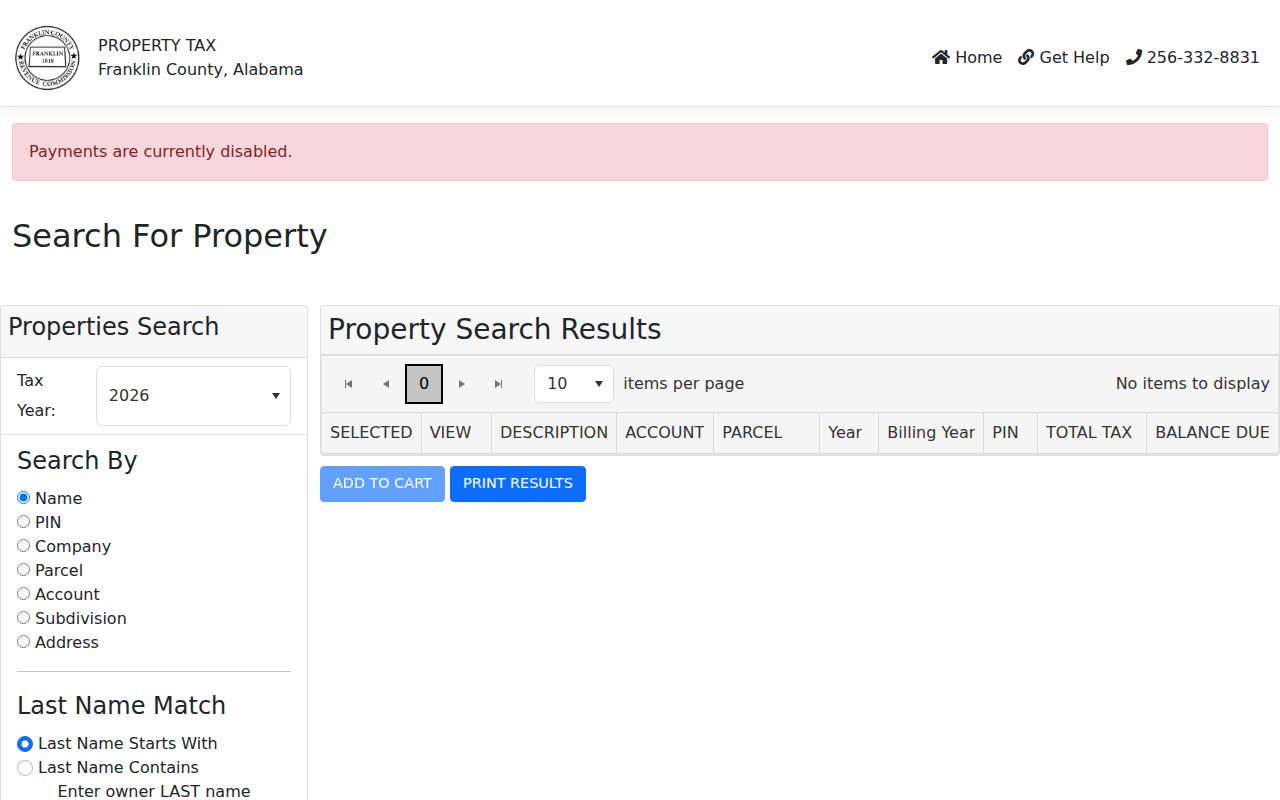
The mode list matters most here. When an owner-name query returns too many matches, searching by property key narrows the results fast.
Alabama Ratios Shape Franklin Taxes
Why do two Franklin County parcels with the same appraised value carry different assessed values? State classification rules are the reason. The Alabama Department of Revenue sets the ratios. Class I utility property sits at 30 percent, Class II at 20 percent, Class IV private passenger vehicles at 15 percent, and Class III qualifying agricultural, forest, owner-occupied residential, manufactured-home, and historic property at 10 percent.
Consider a Class III home. Its assessed value starts at ten percent of appraised value before exemptions touch the taxable figure. That ratio is a state rule, not a local opinion about what the Franklin County property would fetch in an open sale. Verify classification against the county roll. Never infer it from how a building looks or how it is used.
The state assessment explanation lays out the formula. It walks from appraisal to assessment and adds context for reading Franklin County property tax records.
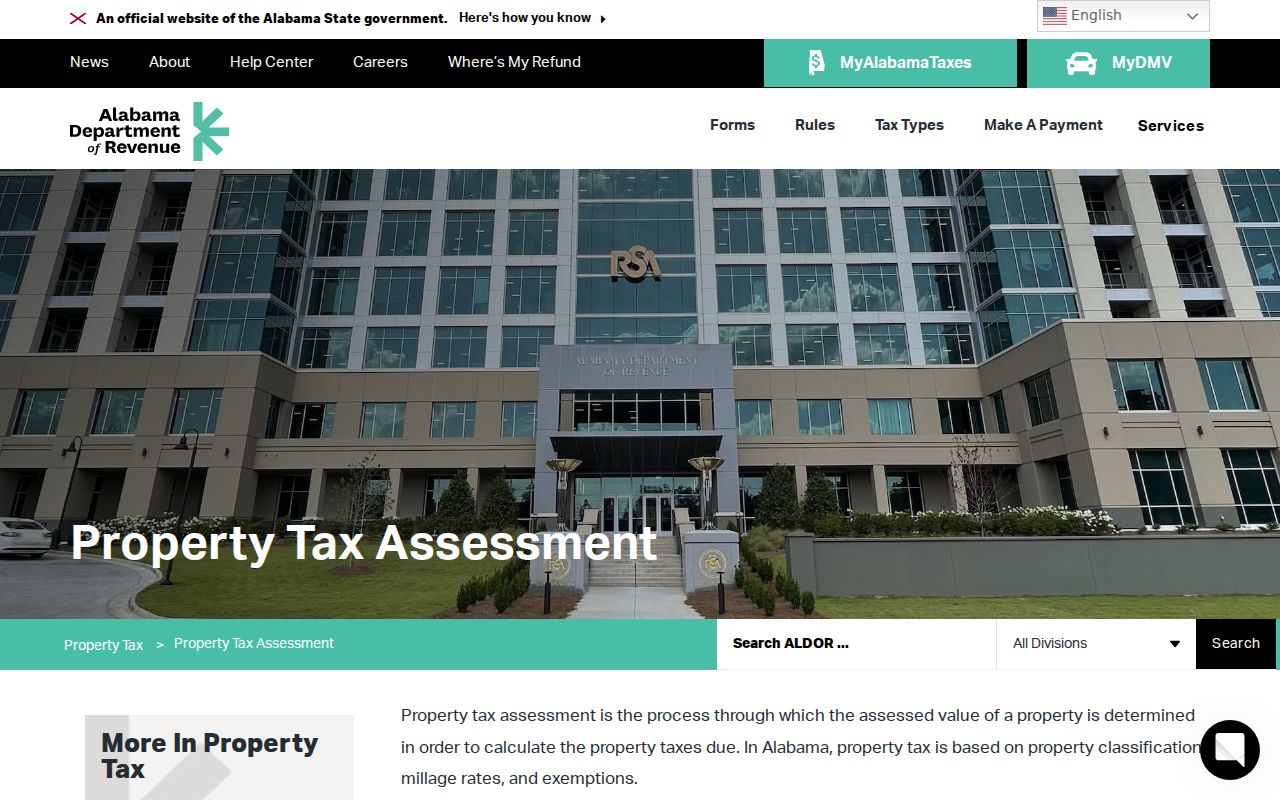
This statewide formula helps separate the county's appraised, assessed, and taxable fields.
Look Up Franklin County Taxes
Begin the lookup online. Reach the Revenue Commissioner by phone or at the courthouse whenever the portal is down. The legacy IASWorld home once exposed Tax Bill Search beside its property modes, but it now posts a maintenance notice and labels its data informational. Its last update came August 28, 2026. Confirm any payoff or time-sensitive amount with the office directly.
- Open the modern portal and select the correct tax year.
- Choose address, parcel, PIN, account, subdivision, company, or owner name. Copy the exact parcel key from the result.
- Open the bill channel and compare the year, billed amount, and payment or delinquency status.
- Check the assessment for appraised, assessed, taxable, and exemption entries. Save the query date.
- Call the Revenue property lines at (256) 332-8831 or (256) 332-8841 if the online amount is unclear or a current payoff is needed.
- Assessed value
- Appraised value after the state class percentage is applied.
- Mill rate or levy
- The tax rate applied to the taxable base by the relevant taxing authorities.
- Homestead exemption
- Relief for a qualifying primary, owner-occupied residence under Alabama rules.
- Tax lien
- A public claim tied to unpaid property tax; it is not the same as clear title.
Franklin County Homestead Record Clues
Alabama's homestead guidance sorts exemptions into H-1 through H-4. Each category carries its own age, disability, income, and tax scope. The core property test is strict. It covers a single-family, owner-occupied dwelling on no more than 160 acres. The property must be held as the owner's primary residence on January 1. Qualifying owners must show eligibility to the Franklin County Revenue Commissioner.
An exemption changes taxable value. It may not change the county's appraisal of the whole property. That gap explains why numbers on a tax record do not always fall in step. Ask the office which proof fits the category claimed. Relief does not follow a deed automatically after a purchase.
Note: Exemption status belongs to its tax year. Verify it whenever ownership or occupancy changes.
Franklin County Annual Value Review
Alabama counties reappraise one-fourth of the county each year, according to state purchase-property guidance. New construction joins the roll the next tax year. Franklin County publishes no quadrant schedule. So a change in appraised value may reflect the annual review cycle, new construction, or updated parcel facts rather than a recent sale.
A newly recorded deed can also precede any change on the tax bill. The old owner's name may linger there. The ALDOR buyer guidance tells buyers to record the deed, assess the property, and expect a bill that stays in the previous owner's name. Franklin County property tax records serve as an assessment source. Probate holds the recorded ownership instrument.
Franklin County Delinquent Tax Trail
The Revenue Commissioner routes tax sale lien activity through GovEase. That platform's general pages do not carry a Franklin County sale list. They lack parcel fields, dates, and bidder terms too. Treat any listing there cautiously. Get the current list and calendar from the Revenue Commissioner. A general platform page is not a county notice. Alabama sets property taxes due October 1. They become delinquent after December 31.
The state delinquent-land source draws a sharp line between two outcomes. State-held property under three years can yield a certificate assignment. After more than three years, a tax deed becomes possible. Neither document necessarily grants clear title, the state warns. Before buying, search Probate for any later tax-sale deed. Match its legal description and parcel key against the parcel number you hold.
Title caution. A tax-sale certificate or tax deed may remain subject to defects, redemption rights, and prior encumbrances.
Contest a Franklin County Assessment
An owner disputing a county value should start with homework. Confirm the parcel, class, building facts, acreage, exemptions, and tax year with the Revenue Commissioner. Then build the case. Comparable sales, photographs, a survey where acreage is disputed, repair evidence, and a qualified appraisal can show why the tax roll is wrong. A deed price alone proves little. It may reflect a non-arm's-length sale or a market that has moved since recording.
Two appeal clocks run in Alabama, and they are easy to confuse. Alabama Code §40-3-25 gives an owner 30 days from a Board of Equalization decision. That deadline runs to circuit court. The Department of Revenue's final-assessment guidance describes a separate 60-day appeal setting. That one applies to a final assessment. Verify which notice the county actually issued. Calculate the deadline from that notice, then file with the office it names.
Protect the deadline. A board appeal may have a 30-day court deadline, while a state final assessment may use 60 days. Read the actual notice and confirm the correct route at once.