
Start a Franklin County Property Records Search
Three systems hold Franklin County property records. The Revenue Commissioner keeps the parcel and tax-roll entry. The Probate Judge records deeds and other land instruments. A county-linked ISV viewer places the parcel on a map. An address, owner name, or PIN opens the Revenue search. From there, a deed book and page, grantor, grantee, or legal description moves the inquiry into Probate records.
Use each record for its own purpose. The tax roll gives a current ownership clue and assessment data. The recorded deed documents a transfer, while the GIS viewer locates land without surveying it. For a clear and repeatable route:
- Enter the street address in the modern Revenue Commissioner property search.
- Save the owner spelling, parcel or PIN, legal description, and tax year shown.
- Search ING Probate for the deed and related recorded instruments.
- Check the tax portal and ISV map for tax status and geographic context.
- Request a certified Probate copy when the instrument must be relied on.
Details live in the Franklin County property search walkthrough. Save any changing roll or map result with its query date and parcel identifier.
The Franklin County Property Records Desks
Alabama records deeds with the Probate Judge rather than a separate county recorder. Franklin County's Revenue Commissioner blends assessment, collection, and property-search work. One office covers all three. The Circuit Clerk keeps court files. Foreclosures, quiet-title actions, partitions, and judgments live there. When a portal is down or a historic record has not been digitized, the courthouse and Revenue contacts give an offline route.
Franklin County Probate Office
410 Jackson Avenue North
Russellville, AL 35653
(256) 332-8801
Franklin County Revenue Commissioner
410 Jackson Avenue North
Russellville, AL 35653
(256) 332-8831
Franklin County Circuit Clerk
410 Jackson Avenue North
Russellville, AL 35653
(256) 332-8861
The Probate Office takes land-record copy requests by mail. Mail them to P.O. Box 70, Russellville, AL 35653. Court files use the Circuit Clerk and statewide Alacourt channels, not the deed portal.
Three Franklin County Search Keys Open the Roll
The modern Revenue portal searches by owner name, address, PIN or parcel, company, account, and subdivision. The tax-year field matters. An older roll can differ from the latest entry. When the address is incomplete, the legacy IASWorld interface offers separate owner, address, parcel, and advanced searches.
| Starting clue | Best first search | Details to preserve |
|---|---|---|
| Street address | Modern Revenue address mode | Situs form, PIN, owner, tax year |
| Owner name | Revenue owner or company mode | Exact spelling and mailing entry |
| Parcel or PIN | Revenue PIN or legacy parcel mode | Full punctuation and legal description |
| Subdivision | Modern subdivision mode | Lot, block, plat reference |
The legacy address form asks for House Number, Pre-Direction, Street Name, and Street Type. Its advice is simple. Omit the suffix, and use a leading wildcard to sweep a whole street for name variants and nearby parcels. The form even works during main-system maintenance.
Franklin County Revenue Search in View
The official Franklin County property portal is the practical first stop for a current parcel query. Its county-branded entry page opens the Revenue Commissioner search.
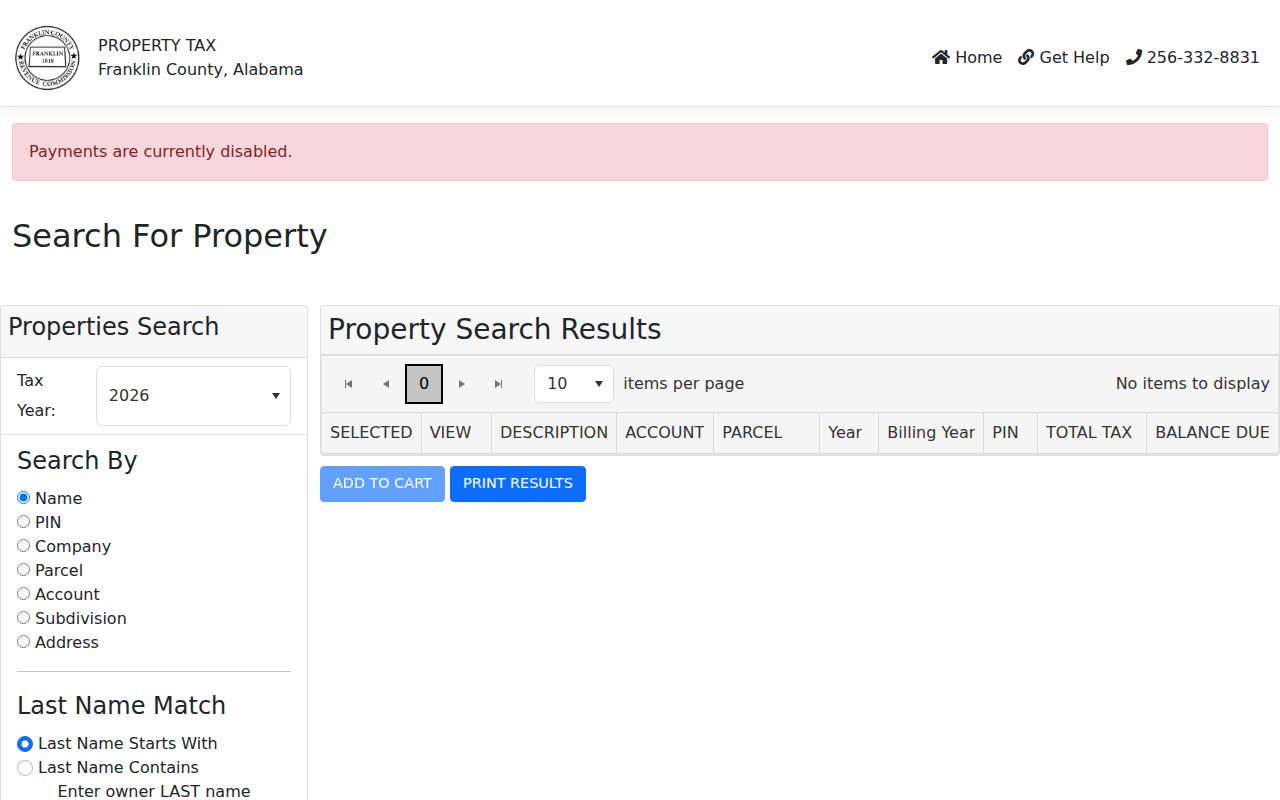
Treat the result as an index clue. Copy the tax year and parcel identifier before moving to the recorded deed.
Franklin County Deeds Begin With ING Probate
The county-linked ING Probate Franklin portal covers land records and Probate case records. Its public landing page spells out accounts, terms, and the land-record route. It lists no index start year. Nor does it price live images. Look for the grantor and grantee first. Then note the instrument type, recording date, deed book and page or document number, legal description, and links to related instruments.
A mortgage, release, easement, lien, plat, or corrective deed can matter as much as the transfer deed itself. Franklin County advertises regular Probate copies at $1 per page. Certified copies run $6. A certified copy goes out the following business day.
Terms used in Franklin land records
Grantor: the party conveying an interest. Grantee: the party receiving it. The parcel or PIN is the Revenue system's land identifier, a plat is a recorded drawing of lots, streets, and dedications, and an assessment is the taxable valuation process rather than a sale appraisal.
Which Franklin County Property Record Answers the Question?
Match the question to the custodian and the trail gets easier. Revenue data points to an owner and assessed values. The Probate instrument documents the transfer. Court files explain lawsuits affecting title, while maps and plats explain geography without proving a surveyed boundary.
| Record Type | What It Documents | Kept By | Access |
|---|---|---|---|
| Deeds | Conveying parties, legal description, recording reference | Probate Judge | ING portal, counter, or mail copy |
| Mortgages and liens | Recorded claims, loans, releases, and easements | Probate Judge | Land-record index and instruments |
| Tax and assessment | Appraised, assessed, taxable values and tax status | Revenue Commissioner | Modern or legacy public search |
| Plats and parcels | Lot, block, parcel position, streets, and dedications | Probate and Revenue | Recorded plat and ISV viewer |
| Court records | Foreclosure, quiet title, partition, and judgments | Circuit Clerk | Local clerk and Alacourt |
Municipal permits are a separate animal. Russellville publishes building, licensing, and zoning materials. Phil Campbell offers permit and business-license service routes. Red Bay publishes no searchable permit-history database, and none of these city records conveys ownership.
Reading Franklin County Values Without Mixing Them Up
Franklin County keeps several numbers on the same property. Mixing them up causes real confusion. The appraised, or fair-market, value comes first. State law then applies an assessment ratio by class. Class III is taxed at 10 percent. The ratio is 20 percent for Class II and 30 percent for Class I. Exemptions and the state's value-cap rules can shrink the taxable figure further. A past sale price recorded in a deed is its own separate evidence. It rarely matches any figure on the tax roll.
The Revenue Commissioner handles annual review and homestead assessment matters. After buying, record the deed and report to the assessing official. A bill may still show the prior owner of record. That does not pass the duty to pay. The Franklin County property tax records page walks through the bill. It also covers the appeal channels in more detail.
What the Franklin County Parcel Viewer Adds
The Franklin County ISV map sits alongside the tax roll as the county-linked geographic tool. Its documented toolkit, per the authoritative ISV guide, includes search, identify, measure, print, buffer or select by location, and export of selected information.
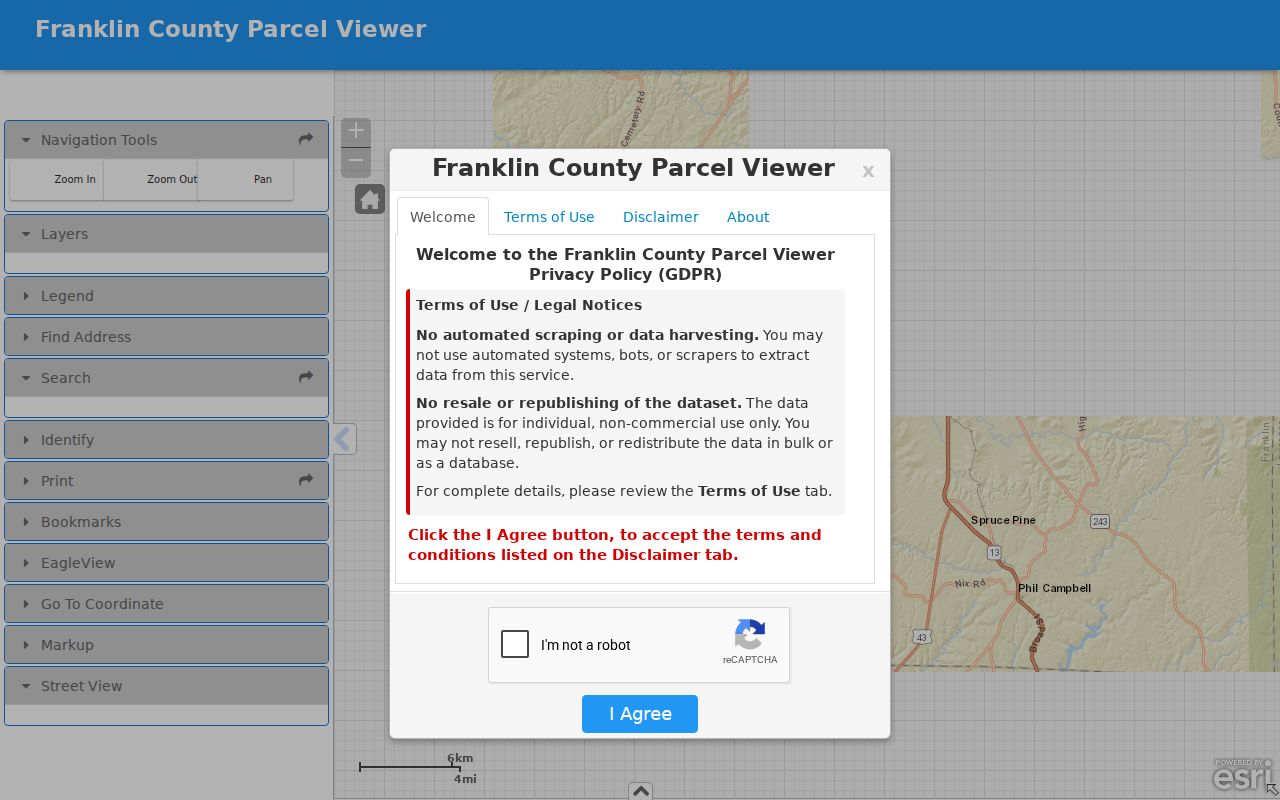
The viewer helps match a parcel number to a place and study the parcels around it. Treat its display as a research aid, not a boundary ruling. A recorded plat, a deed description, and a licensed survey still supply the stronger evidence.
Franklin County Plats Bridge Names and Boundaries
A recorded subdivision plat ties a lot and block to streets, easements, and rights-of-way. It also carries dedications and restrictions. Probate remains the official custodian of plats. Alabama Land Services also posts Franklin subdivision covenants and plats as a discovery convenience. It is a private title-company source, though. It never substitutes for the official copy.
Older descriptions may rely on township, range, and section instead of a street address. The Alabama Secretary of State Lands holds statehood-through-1950 material. The Alabama Archives and University of Alabama map collections preserve older township context. Search the old description first. Then reconcile it with the current parcel and the recorded instruments behind it.
The 1890 Fire Shapes Franklin County Record Searches
Franklin County dates to 1818. Its county seat moved among Russellville, Frankfort, and Belgreen. It settled back in Russellville after the 1890 fire. Local history reports records lost in that blaze. The state's local-law index also points to 1894 abstracts of burned records. It notes earlier reverse-index requirements and later conveyance legislation. So a gap in a modern chain of title should prompt a search for abstracts, re-recordings, corrective deeds, or a later confirmation. Do not assume everything earlier vanished.
That same local-law trail shaped the modern system. Franklin-specific Code provisions built an improved recording, archiving, and retrieval framework inside the Probate Office. An audit confirms related special fees in recent fiscal periods. Neither source, though, pins down the first year available in the online deed index.
Offline Routes for Franklin County Property Records
The portal is only one channel. Probate copies can be requested at the courthouse or by mail. Older deed books, plats, abstracts, and instruments that do not appear online should be requested from Probate with as much detail as possible. Circuit Court records run through the local clerk or the statewide read-only Alacourt service. State land and historic map collections serve as another fallback for older descriptions.
Commission-controlled records follow a different 2025 county procedure. The form demands proof of Alabama residency and in-person delivery at 405 Jackson Avenue North. The county says unsolicited email requests go unacknowledged. Estimated administrative fees may be collected before a search or production begins. Do not confuse that process with the Probate Office's separate land-record copy route.
Make a narrow request. Give the custodian a parcel or PIN, parties, record type, date range, and book/page when known.
Franklin County Court and Distress Records
A deed index alone will not tell the whole story. That is often the case when land is tied to foreclosure, quiet title, partition, probate administration, or a judgment. The Franklin County Circuit Clerk keeps trial-court records, while Alacourt offers statewide read-only case access. Federal matters run through PACER and the Northern District of Alabama. Sealed, juvenile, family, and protected records carry separate limits.
Tax distress follows the Revenue Commissioner and state channels. Franklin links GovEase for auctions. The Alabama Department of Revenue explains state-held certificates, tax deeds, the Book of Lands, May sales, and redemption. A tax certificate or deed may not provide clear title. Check prior encumbrances and the redemption posture before relying on either.
Franklin County Deed-Fraud Checks in 2026
Franklin County publishes no property-fraud alert subscription. A practical check compares the tax-roll owner against the newest Probate instrument. Anything suspicious should go straight to the Probate Office. The Alabama Property Protection Act takes effect October 1, 2026. It addresses seller impersonation and false instruments. That timing makes the cross-check timely.
Preserve the portal URL, query date, and tax year. Keep the owner spelling, parcel or PIN, and deed reference as well. Do not publish signatures, full financial numbers, protected addresses, or other unneeded identifiers. Court rules and specific Alabama statutes restrict some protected information. The record system itself remains public.
Limits of Franklin County Property Records
Franklin County property records answer many questions well. They show the owner of record on the tax roll. They list the parties to a recorded deed, legal descriptions, assessed figures, tax status, and recorded encumbrances. What they cannot do is just as important. Records do not guarantee clear title. They cannot prove a lien is still enforceable. They cannot settle a boundary on the ground or predict what a parcel will sell for. A tax roll can also lag behind a new deed. A GIS line may not match surveyed evidence.
Alabama law supports broad access to public writings. Ala. Code §§36-12-40 and 36-12-45 open the door while leaving record-specific restrictions and custodian procedures in place. Birth and death records stay limited, as do sealed court, juvenile, adoption, domestic-violence, and protected-address files. Use only the property-relevant details a lawful inquiry requires. When a name or address conflicts across systems, resist picking the most convenient result. Instead, note the tax year, recording date, and source of each version. That small audit trail lets Probate or Revenue staff see the mismatch clearly. It also sends a correction request to whichever office actually controls the record.
Use records with care. Public access supports property research and civic review, but no record may be used to stalk, harass, or harm a person.